
Would you take advice from these guys?
by smbrannan
We have about 20 entries so far, which I think is pretty good. If I don’t have yours, don’t procrastinate any longer. Send in your picks today. And recruit your friends and family.
If you are looking for more inspiration, here is some from the masters of the universe. The “GS Probability” column shows Goldman Sachs’ estimate of the likelihood that each team will win the cup. (click on image to enlarge)
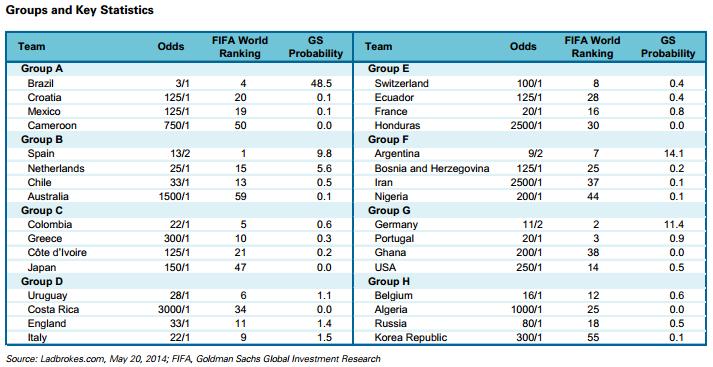
Here is Goldman Sachs description of how they came up with these predictions:
At a very high level, our approach is as follows:
- We construct a stochastic model that generates a distribution of outcomes for each of the 64 matches of the 2014 World Cup, from the opener between Brazil and Croatia on June 12 in São Paulo through the final on July 13 in Rio de Janeiro.
- The predictions for each match are based on a regression analysis that uses the entire history of mandatory international football matches—i.e., no friendlies—since 1960. This gives us about 14,000 observations to estimate the coefficients of our model. The dependent variable in the regression analysis is the number of goals scored by each side in each match. Following the literature on modelling football matches, we assume that the number of goals scored by a particular side in a particular match follows a Poisson distribution.
- We generate a probability distribution for the outcome of each game using a Monte Carlo simulation with 100,000 draws, using the parameters estimated in the regression analysis described above. We use the results of this simulation analysis to generate the probabilities of teams reaching particular stages of the tournament, up to winning the championship. We use the rounded prediction of the goals scored to determine the outcomes of each game during the group stage and the unrounded forecast to pick the winner in the knockout stage.
- To be clear, our model does not use any information on the quality of teams or individual players that is not reflected in a team’s track record. For example, if a key player who was responsible for a team’s recent successes is injured, this will have no bearing on our predictions. There is also no role for human judgment as the approach is purely statistical.
Use at your own risk.
More gibberish in the full report, here.
 The Beautiful Pool